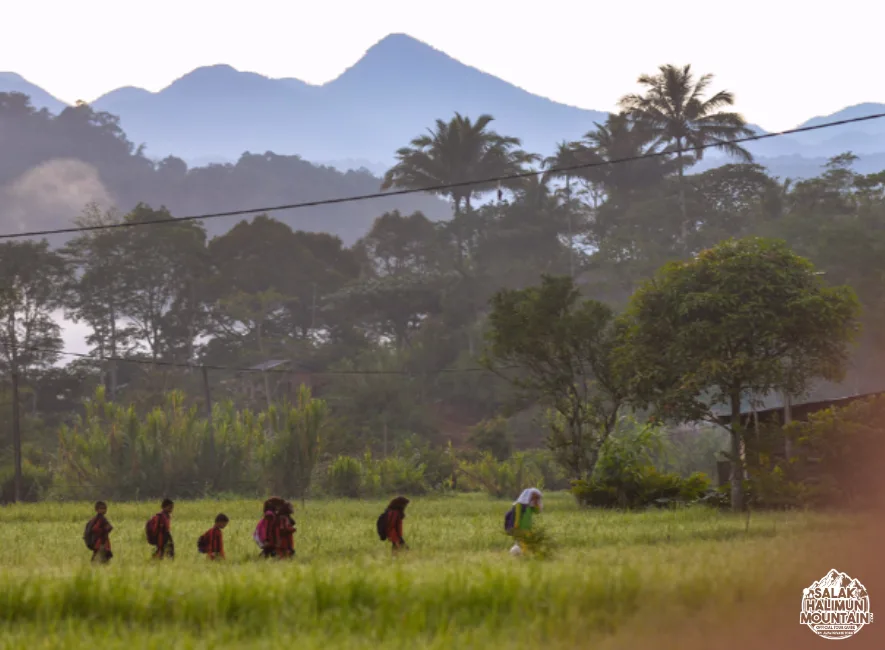
salakhalimunmountain.com – At dawn, when mist still clings to the forest canopy of Mount Salak and Mount Halimun, you can often hear life stirring at the forest’s edge. Roosters crow from bamboo yards, wood smoke drifts from kitchen fires, and somewhere deeper in the trees, cicadas begin their steady rhythm. This meeting place between village and rainforest is no coincidence. Across the Salak Halimun region, many villages sit carefully along forest edges, shaped by generations of ecological wisdom, cultural tradition, and practical survival.
The Forest Edge as a Place of Balance
Forest edges are not borders of separation. In Salak Halimun, they are zones of balance. Here, human life and rainforest life meet, interact, and adapt to one another. Villages are rarely built deep inside the dense primary forest, yet they are also not far removed from it. Instead, homes settle where the canopy thins, where sunlight reaches the ground, and where paths naturally form.
This balance allows villagers to live close enough to the forest to benefit from its resources while respecting its power. The rainforest provides water, food, materials, and protection. At the same time, living at the edge reduces the risks of landslides, falling trees, and the overwhelming humidity that defines the deep jungle.
Access to Water Sources
One of the most important reasons villages sit near forest edges is water. In Salak Halimun National Park, countless springs are born under thick roots and moss-covered rocks. These springs flow gently downhill, becoming streams and rivers that sustain both wildlife and people.
By living near the forest edge, villagers remain close to clean, reliable water sources without disturbing the fragile heart of the forest. Bamboo pipes still carry spring water into homes in some areas, following gravity and tradition rather than modern pumps. The forest protects these springs by holding soil in place, filtering rainwater, and releasing it slowly throughout the year.
Rainforest Roots and Natural Filtration
The massive root systems of rainforest trees act like natural reservoirs. They absorb heavy rainfall during monsoon seasons and release it gradually, preventing floods and ensuring steady water flow during drier months. Villages near forest edges benefit directly from this natural system.
Fertile Land for Farming
Forest edges often offer the most fertile land. Over centuries, fallen leaves, branches, and organic matter decompose into rich soil. This soil is ideal for small-scale agriculture, which has long supported village life around Mount Salak and Mount Halimun.
Rice fields, vegetable gardens, and fruit trees are usually found just beyond the forest line. Bananas, cassava, chilies, and coffee thrive in the nutrient-rich earth. Farmers understand the rhythm of the forest, planting crops that benefit from partial shade and natural moisture.
Importantly, traditional farming practices here respect forest boundaries. Clearing is limited, rotation is practiced, and sacred groves are left untouched. This approach ensures long-term fertility rather than short-term gain.
Natural Protection From Harsh Weather
The rainforest is a living shield. Villages positioned near forest edges gain protection from strong winds, heavy rains, and extreme temperature changes. Tall trees break the force of storms that roll across the mountains, while dense vegetation stabilizes slopes and reduces erosion.
During the rainy season, when clouds wrap Mount Salak in near-constant mist, forest cover prevents landslides that could otherwise threaten homes. The forest edge is often the safest place to settle, offering security without isolation.
Access to Forest Resources
For generations, forest resources have been essential to daily life. Villages near forest edges allow people to gather what they need without overexploitation. Firewood, medicinal plants, rattan, bamboo, and edible leaves are collected carefully and seasonally.
Local knowledge plays a critical role. Elders know which plants can be harvested without harm, which roots should never be touched, and which areas must remain undisturbed. This deep understanding has been passed down through stories, rituals, and everyday practice.
Medicinal Plants and Traditional Knowledge
Many villagers still rely on forest plants for traditional medicine. Leaves to reduce fever, roots to ease stomach pain, and bark used for herbal teas are all found close to the forest edge. This proximity keeps ancient healing knowledge alive.
Wildlife Awareness and Respect
Living near the forest edge also shapes how villagers understand wildlife. Encounters with animals are part of daily life. The call of gibbons echoes in the morning, while civets and deer may pass quietly at night.
This constant presence fosters respect rather than fear. Villagers know animal behavior patterns and adjust their activities accordingly. Crops are protected with natural barriers, and hunting is limited or avoided entirely in many communities.
By staying near the forest edge, humans and wildlife maintain a cautious coexistence, guided by awareness rather than dominance.
Cultural and Spiritual Connections
In Salak Halimun, forests are not just ecosystems. They are spiritual spaces. Many villages believe certain forest areas are sacred, inhabited by ancestral spirits or guardians of the land.
Living near the forest allows communities to maintain rituals tied to nature. Ceremonies marking planting seasons, harvests, or important life events often involve offerings placed at forest boundaries. These traditions reinforce respect for nature and remind each generation of their responsibility to protect it.
Ease of Movement and Trade
Forest edges naturally become pathways. Trails used by wildlife often evolve into human routes, connecting villages, fields, and water sources. Over time, these paths link communities across the region.
Villages positioned at forest edges can access both mountain resources and lowland trade routes. This location historically supported exchange of goods like rice, forest products, and handmade crafts, strengthening regional connections.
A Sustainable Relationship With the Land
Perhaps the most important reason villages sit near forest edges is sustainability. This placement reflects an understanding that humans are part of the ecosystem, not separate from it.
By avoiding deep forest settlement, communities reduce deforestation and protect biodiversity. By staying close, they remain connected, aware, and accountable. This balance has allowed Salak Halimun to remain one of Java’s richest rainforest regions.
Lessons for Modern Travelers
For visitors exploring Mount Salak and Mount Halimun today, these villages offer powerful lessons. They show that living with nature is not about conquering landscapes but listening to them.
As you trek muddy trails or cross bamboo bridges near village edges, notice how homes follow the land’s contours, how gardens blend into forest shade, and how daily life moves with the rhythm of rain and sunlight. This is not accidental design. It is the result of generations of observation and respect.
Responsible Exploration Matters
When visiting villages near forest edges, travelers should move gently. Respect private spaces, ask permission before taking photos, and follow local guidance. Remember that these are living communities, not attractions.
Supporting responsible trekking and local guides helps ensure that this balance remains intact. Your presence should leave no trace, except appreciation.
Understanding why villages sit near forest edges deepens our connection to Salak Halimun. It reminds us that the rainforest is not empty wilderness but a shared home shaped by mutual care.
So, if you’re ready to explore the wonders of Mount Salak Halimun, head over to our ONLINE BOOKING PAGE and let’s start planning your adventure. Or simply CLICK THIS LINK to chat with us on WhatsApp.
With our team, you’re not just getting a guide; you’re gaining a local friend who will ensure your trip is nothing short of extraordinary.